

ENCALADA LAB

Endolysosomal Membrane Trafficking, Neurodegeneration, and Neuro-Therapeutics
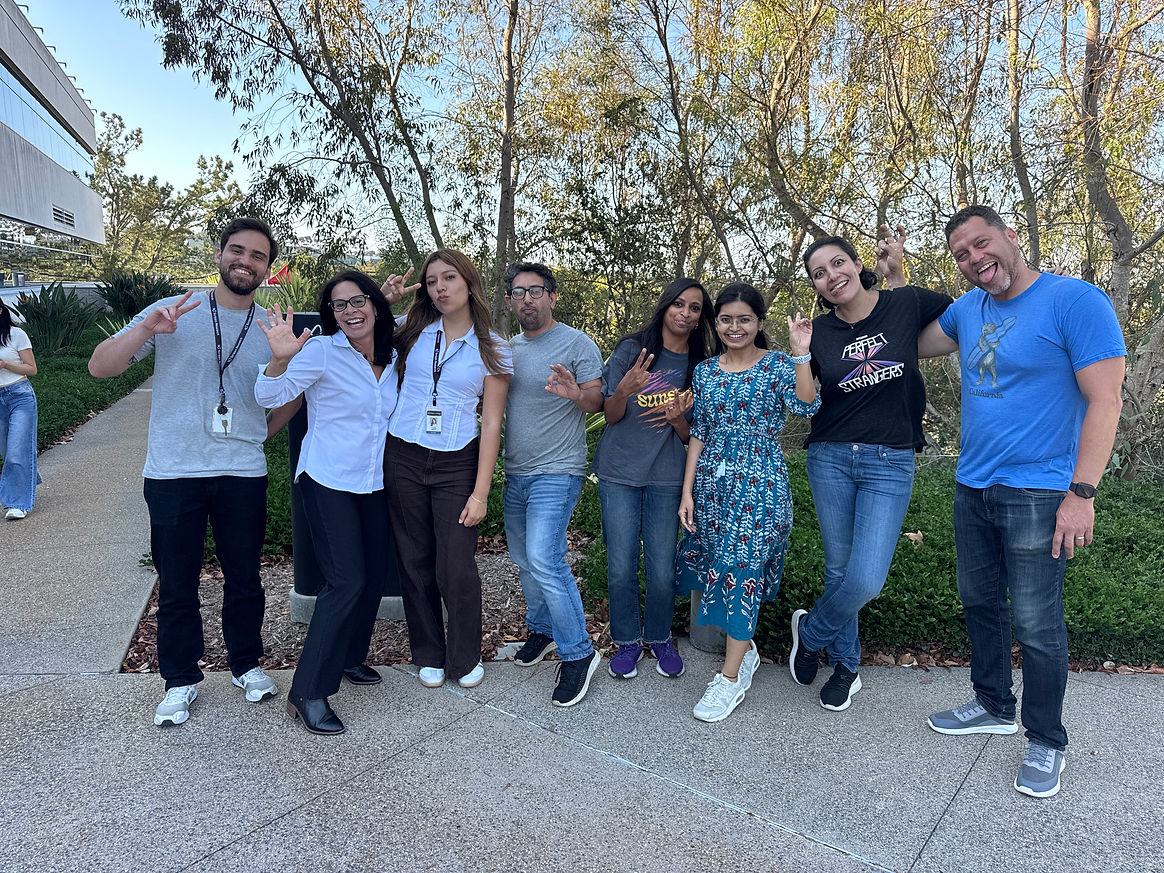
TEAM ENCALADA



Sandra E Encalada, PhD
Principal Investigator
Arlene and Arnold Goldstein Associate Professor
encalada [at] scripps [dot] edu
Sandra is an Associate Professor in the Department of Molecular Medicine and an Investigator of the Dorris Neuroscience Center, and of the Neurodegeneration New Medicines Center at Scripps Research. She received her International Baccalaureate (I.B.) degree from the United World College - USA, and her B. A. from Earlham College in Physics with a minor in Biology. Sandra obtained her PhD in Molecular Genetics from the University of Oregon, where she studied under the mentorship of Bruce Bowerman. She was a Damon Runyon Postdoctoral Fellow at UC San Diego in the laboratory or Larry S. B. Goldstein where she characterized the mechanisms of transport of the prion protein. She is the recipient of The Glenn Foundation Award for Research in Biological Mechanisms of Aging, The Baxter Foundation Young Faculty Award, and The Ellison Medical Foundation New Scholar in Aging Award. Outside of the lab, she enjoys swimming in the ocean, playing the piano, and picking bugs with her daughter.

Delany Rodriguez Lara, PhD
Staff Scientist/ Lab Manager
derodriguez [at] scripps [dot] edu
Delany F. Rodriguez, Ph.D., is a staff scientist and lab manager specializing in molecular and cellular biology, with a focus on prion disease, aging, vascular biology, and developmental biology.
Delany's academic journey began at the National Autonomous University of Morelos in Mexico, where he earned a Bachelor of Science in Biology with honors. He furthered his education at New Mexico State University, obtaining a Master's in Molecular Biology, with his research focusing on the role of ion channels in sperm physiology. He then pursued his Ph.D. in Molecular Biology at New Mexico State University, with research centered on the spatial regulation of cytokinesis in sea urchin embryos. Throughout his career, Delany held key research positions, including a postdoctoral fellowship at the University of California, Santa Barbara, supported by the California Institute of Regenerative Medicine (CIRM). Notably, his work in the De Tomaso lab significantly advanced the understanding of germ cell development, vasculature dynamics, and aging in the ascidian Botryllus schlosseri. He then studied epigenetic changes and their effect on biological age in both mice and humans at the Sanford Burnham Prebys Medical Discovery Institute.
Currently, Delany is actively engaged in groundbreaking research, employing super-resolution microscopy to investigate the role of Prion proteins in disease. His work aims to unravel the intricate details of disease mechanisms at the molecular level, further enhancing our understanding of these complex processes. Outside of the lab, he loves surfing, snowboarding, hiking, and traveling around the world.

Jaycee Baker Saunders
Molecular and Cellular Department Manager
Laboratory Administrative Coordinator for Encalada Lab
jbakersa [at] scripps [dot] edu
Jaycee is the Director of Research Administrative Services at Scripps Research. With a background in accounting and office management, she started at Scripps Research in 2007 in the Molecular and Experimental Medicine department, supporting Dr. Frank Chisari and four junior faculty who researched liver diseases, primarily around Hepatitis B and C. Over the years she continued to rise through the ranks, supporting multiple labs and departments and was promoted to Director in 2023. While leading a team of over 60 Laboratory Administrative Coordinators she is currently the Department Manager for the Molecular and Cellular Biology Department and helping to support the Encalada lab.

Dikshaa Padhi is a Postdoctoral Fellow. She investigates the mechanisms of neurodegeneration in prion diseases and related proteinopathies. She completed her Integrated BS-MS in Chemical Sciences and earned her Ph.D. in Chemical Biology at the Jawaharlal Nehru Centre for Advanced Scientific Research (JNCASR), Bengaluru, India. Her doctoral research focused on developing multifunctional small molecules to mitigate amyloid toxicity and ferroptosis, and on uncovering how underexplored post-translational modifications drive liquid-liquid phase separation (LLPS) and aggregation of tau and Aβ in Alzheimer’s disease. Driven by a deep interest in the molecular basis of neurodegeneration, she is currently expanding her expertise to the biochemical and in vivo characterization of LLPS and aggregation of mutant prion proteins, and the therapeutic targeting of condensates in mammalian neurons and in mice. Beyond the lab, she enjoys acrylic painting, exploring libraries steeped in history, travelling and conversations with her parents.
Postdoctoral Fellow
dpadhi [at] scripps [dot] edu
Dikshaa Padhi, PhD
Amir Jaberzadeh, PhD
Research Programmer
ajaberzadeh [at] scripps [dot] edu
Amir earned his B.S. and M.Sc. in Biomedical engineering, followed by a Ph.D. in computer science. He developed advanced solutions in machine learning, high-performance computing, image analysis, and scientific visualization. As a researcher at the University of Southern California, Amir developed accelerated techniques for brain analysis, MRI image synthesis, and image standardization. At Harvard Medical School, he created high-performance computing solutions for diffusion imaging that were later incorporated into the Insight Toolkit (ITK), a widely used open-source platform for medical image analysis. He also conducted research at the University of Strasbourg, where he designed software for image-guided interventions, tissue modeling, image analysis, and 3D visualization. He has also played a key role in developing image computing and quantification technologies for medical applications that received FDA clearance. His technical expertise encompasses machine learning, computer vision, conversational AI, large-scale data analytics, distributed and cloud computing, databases, networking, virtualization, concurrency, signal processing, computer architecture, blockchain, medical devices, digital and analog electronics, enabling him to bridge cutting-edge research with practical commercial applications. Amir’s projects in the Encalada Lab include the development of scalable image analysis pipelines for complex microscopy and biomedical imaging datasets that are applied to drug discovery high-throughput campaigns. On his free time, Amir enjoys staying active by hiking and spending time in nature.

Carolina Maciel Camargo, PhD
Postdoctoral Associate
cmaciel [at] scripps [dot] edu
Carolina earned her B.S. in Biological Sciences, and M.Sc. in Genetics from UFPR in Brazil, followed by a Ph.D. in Molecular, Cellular, and Developmental Biology from UC Santa Barbara. Her doctoral research focused on progranulin deficiency in neurodegeneration, utilizing human iPSC-derived brain organoids, microglia, and neurons. During her initial postdoc at UCSB, she transitioned into in vivo drug discovery, evaluating the brain penetration and efficacy of farnesyl transferase inhibitors on tau pathology. Throughout her time at UCSB, she developed expertise in single-cell sequencing, fluorescence microscopy and image analysis, and complex cell-based functional assays. Now in the Encalada Lab, she is applying her multidisciplinary background to investigate the mechanisms of prion diseases using transgenic mouse models. During her free time, she enjoys spending time outside with her dog, watching crime shows and exploring new places to eat and drink.


Lucas Martins
Visiting Graduate Student
lmartins [at] scripps [dot] edu
Lucas earned his B.S. in Biological Sciences with a concentration in Genetics and his M.Sc. in Biological Chemistry from the Federal University of Rio de Janeiro (UFRJ), Brazil. Throughout his undergraduate and master's training, he investigated the molecular mechanisms underlying transthyretin amyloidosis. Currently, Lucas is pursuing his Ph.D. in Biological Chemistry at UFRJ. His research focuses on understanding the molecular mechanisms that regulate amyloid protein aggregation and identifying small molecules capable of modulating these processes. His work integrates biophysical, biochemical, and cellular approaches to investigate protein misfolding, amyloid formation, and the mechanisms underlying amyloid inhibition and disassembly. As an Exchange Visitor Ph.D. student in the Encalada Lab, Lucas uses high-content fluorescence imaging platforms and machine learning-based image analysis in automated high-throughput platforms to screen for small molecules that clear misfolded protein aggregates in cellular models of disease. Outside of the lab, Lucas enjoys outdoor activities, reading, watching soccer, and being with family and friends.

Sharada Gopal, PhD
Postdoctoral Associate
sharadag [at] scripps [dot] edu
Sharada Gopal earned her B.Tech. in Biotechnology Engineering from R. V. College of Engineering in Bangalore, India, followed by an M.Eng. in Biomedical Engineering and a Ph.D. in Biological and Biomedical Sciences from Cornell University. Her doctoral research in the Siu Sylvia Lee lab defined a somatic checkpoint through the nuclear hormone receptor NHR-49 that governs oocyte activation, reproductive investment, and longevity in C. elegans, work combining genetics, imaging, genome-wide binding profiles, transcriptomics, and tissue-specific transgenics. In the Encalada Lab, she investigates the mechanisms of neurodegeneration in prion disease, focusing on endoggresomes, aggregates of mutant prion protein that accumulate within axonal endolysosomes. Beyond the lab, she enjoys swimming, working out, hosting, spending time with her partner and dog, and conversations with her parents and friends.
ALUMNI
Graduate Students:
Yin Wu, PhD - Postdoctoral Fellow at University Medical Center Göttingen
Tai Chaiamarit, PhD - Principal Investigator Mahidol University
George Campbell, PhD - Sr. Researcher at St. Jude Children's Research Hospital
Miguel Alves Ferreira, PhD - Clinical Scientist and Invited Auxiliary Professor at School of Medicine and Biomedical Sciences (ICBAS), University of Porto.
Postdoctoral Fellows:
Mariana Do Amaral, PhD.
Adriaan Verhelle, PhD, Business Development Manager at OHMX.bio
Nandini Shukla, PhD, postdoctoral researcher UCSD
Adeola Adeyemo, PhD, Technical Support Scientist at Advanced Cell
Diagnostics
Romain Chassefeyre, PhD - Project/Team Leader at Evotec, France
Sylvia Neumann, PhD - Project Scientist and Lab Manager, UCLA
Erin Greiner, PhD - Territory Account Manager, Illumina, San Diego
Assistants:
Nirvan Rouzbeh, Doctoral Graduate Student, University of Montana
Diana Gonzales, Research Assistant at DKFZ German Cancer Research Center
Jesse Holt
Andrew Huang
Cynthia Cho
Leena McCann, Senior Scientist at Cepheid
Back to Top